This work addresses a simple but important question: if Price-law tails are a generic prediction of black-hole perturbation theory, why are they so weak or absent in many numerical-relativity waveforms of binary black-hole mergers? The answer proposed here is spectral. Oscillatory perturbations deplete the low-frequency content that feeds the branch cut of the Green's function, exponentially suppressing the late-time tail.
The puzzle
In black-hole perturbation theory, a compact perturbation of a Schwarzschild black hole has three main stages: prompt response, quasinormal ringing, and a late-time power-law tail. For a timelike observer at fixed radius, Price's law predicts
For the quadrupolar sector, $\ell=2$, this gives a leading decay $\Psi_{\rm tail}\sim t^{-7}$. Yet in quasi-circular binary-black-hole simulations, this component is typically much harder to identify than in standard perturbative evolutions with non-oscillatory Gaussian initial data.
The key observation of the paper is that merger-like sources are not just localized: they are also oscillatory. Their spectral support is concentrated away from zero frequency. Since the late-time tail is controlled by the branch cut around $\omega\simeq0$, this naturally suppresses the tail amplitude.
Oscillatory Gaussian data
The mechanism is isolated using a family of localized oscillatory Gaussian perturbations,
Here $\sigma$ is the characteristic width of the pulse and $\nu$ is the carrier frequency. The relevant dimensionless parameter is
This parameter counts, roughly, how many oscillations fit inside the Gaussian envelope. For $\alpha\lesssim1$, the source remains broadband and has significant support near $\omega\simeq0$. For $\alpha\gg1$, the spectrum becomes frequency-selective and is centered around $\omega\simeq\pm\nu$.
Branch-cut suppression
The late-time tail comes from the branch-cut contribution of the frequency-domain Green's function. For compact initial data, the tail coefficient is controlled by weighted moments of the initial perturbation and its initial velocity. For $\ell=2$, the late-time waveform can be written as
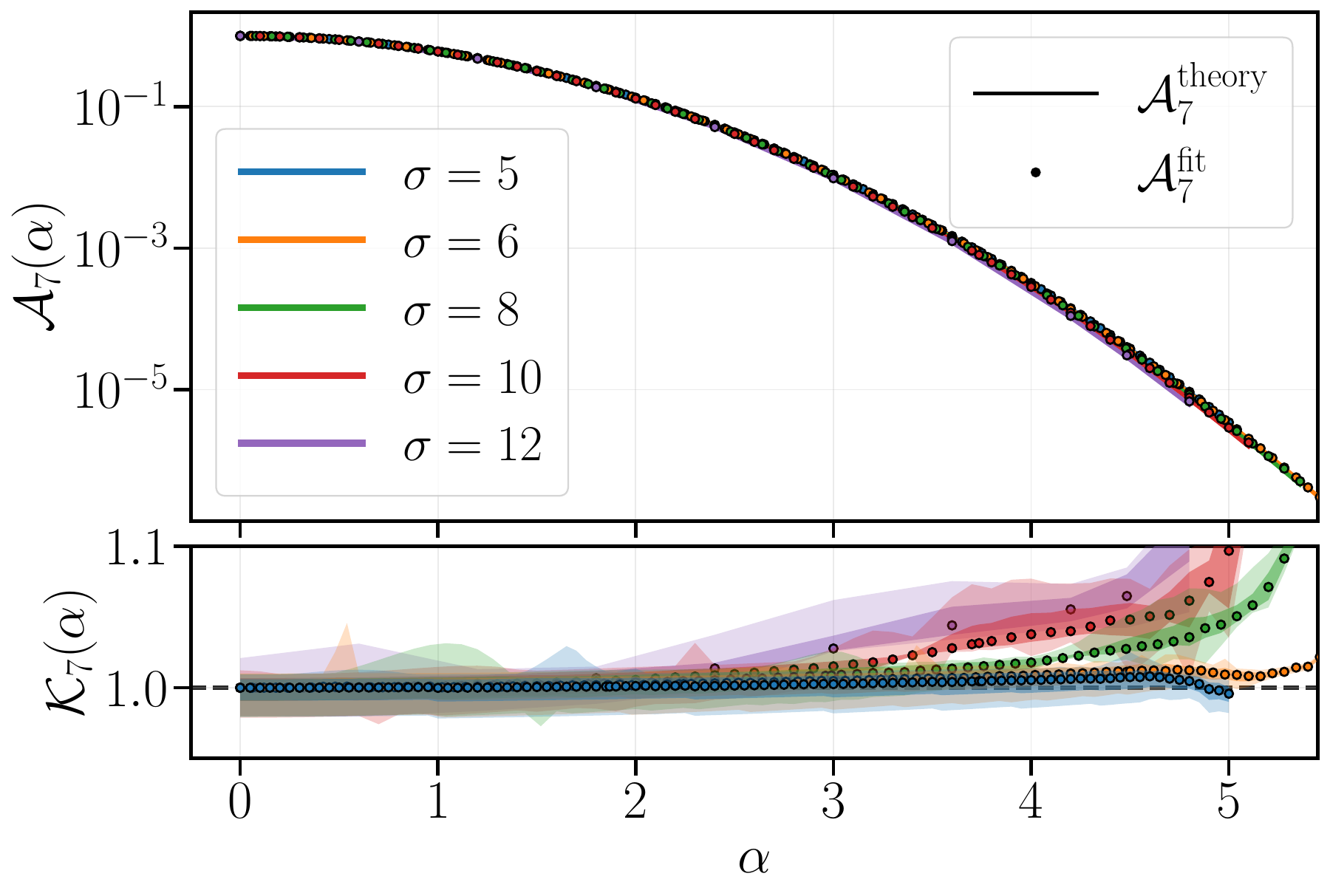
The leading coefficient $a_7$ is the main tail amplitude measured in the simulations. For oscillatory Gaussian data, the branch-cut moments inherit the low-frequency suppression of the Fourier transform. In the asymptotic regime, both the leading and next-to-leading tail coefficients factorize into a slowly varying prefactor times $e^{-\alpha^2/2}$:
More explicitly, for $\ell=2$ and $r_0\gg\sigma$, the leading asymptotic expressions take the schematic form
Thus, the dominant suppression mechanism is universal within this family of sources: increasing $\alpha$ removes spectral weight from $\omega\simeq0$, and the branch-cut contribution becomes exponentially small.
Competition between QNMs and tails
The same spectral parameter $\alpha$ also controls the relative importance of quasinormal ringing and the late-time tail. The QNM amplitude is enhanced when the carrier frequency is close to the real part of the quasinormal-mode frequency,
At the same time, the tail amplitude is suppressed by the depletion of low-frequency spectral support. Therefore, oscillatory perturbations can simultaneously produce a cleaner QNM-dominated response and a much weaker Price-law tail.
For the fundamental mode, the ratio between QNM and tail amplitude can be summarized schematically as
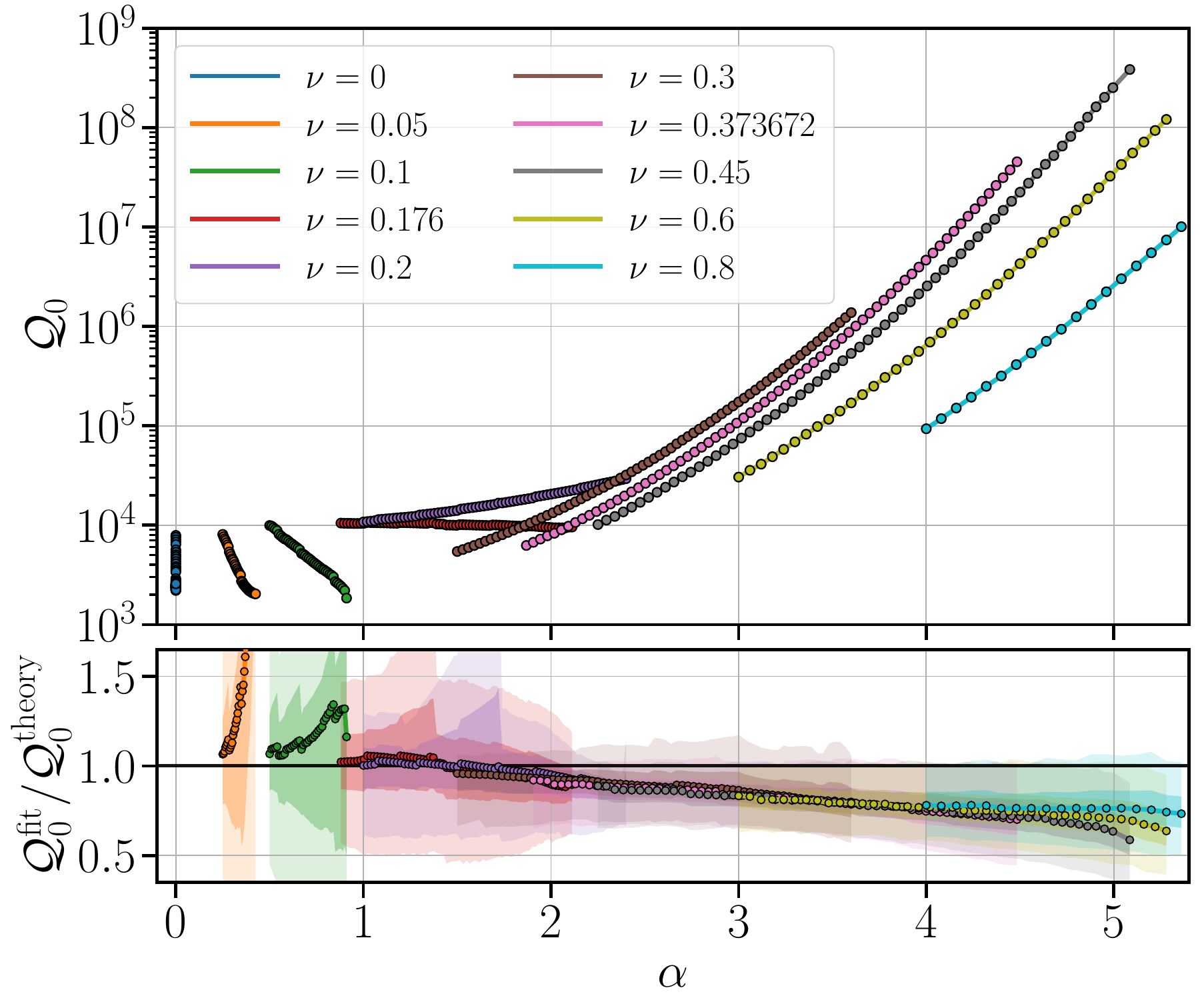
This expression explains why tuning the source toward the QNM frequency increases the relative visibility of the ringdown while suppressing the tail. It also predicts a transition between tail-dominated and QNM-dominated behavior. For the fundamental Schwarzschild mode, the critical carrier frequency is approximately
Below this value, increasing $\alpha$ does not necessarily enhance the QNM-to-tail ratio. Above it, the exponential suppression of the tail dominates, and the waveform becomes increasingly QNM-dominated.
Numerical validation
The predictions are tested using time-domain evolutions of the Regge--Wheeler equation. The waveform is evolved for different values of $\sigma$ and $\nu$, and the late-time region is fitted with
The tail onset is identified through the local power-law index, and multiple fitting windows are used to estimate the robustness of the extracted coefficients. The agreement between the analytical spectral prediction and the fitted tail coefficients is at the level expected from the asymptotic expansion, with the leading normalized suppression captured accurately across the explored parameter range.
Physical interpretation
The suppression mechanism is not a numerical artifact and does not rely on nonlinear dynamics. It is already present at the level of linear black-hole perturbation theory. The key ingredient is the spectral structure of the source. Non-oscillatory Gaussian perturbations have large low-frequency support and therefore excite the branch cut efficiently. Oscillatory perturbations shift their spectrum away from $\omega\simeq0$, suppressing the branch-cut integral.
This gives a natural interpretation of why tails are difficult to see in quasi-circular binary-black-hole mergers: these systems generate highly oscillatory post-merger perturbations, with effective $\alpha_{\rm eff}\gtrsim1$. By contrast, head-on or eccentric mergers can contain more burst-like, lower-frequency structure, making the tail less suppressed and therefore easier to observe.
Takeaway
The paper identifies a spectral mechanism behind the suppression of black-hole ringdown tails:
The same parameter $\alpha=\sigma\nu$ that controls the transition from broadband to frequency-selective response also controls the suppression of Price-law tails. This links tail visibility directly to the spectral content of the perturbation and provides a perturbative explanation for why quasi-circular mergers are expected to show weak tails, while eccentric or head-on configurations can enhance them.