This paper studies the excitation of black-hole quasinormal modes from a spectral point of view. The central result is that the ringdown amplitude of each mode is controlled by the frequency content of the perturbation that excites the black hole. In this sense, the black hole behaves as a resonant spectral filter: it selects the part of the input perturbation that overlaps with its own quasinormal-mode spectrum.
Ringdown as a filtering problem
In linear perturbation theory, the late-time response of a black hole can be decomposed into a sum of damped oscillations, the quasinormal modes, plus a non-oscillatory late-time tail. Schematically,
The complex frequencies $\omega_n$ are fixed by the background black-hole geometry. By contrast, the excitation amplitudes $C_n$ depend on the perturbation that initially drives the system. The aim of the paper is to make this dependence explicit and controllable.
For perturbations governed by the Regge--Wheeler equation,
the quasinormal modes appear as poles of the frequency-domain Green's function. Near each pole, the excitation coefficient factorizes into a part associated with the black-hole response and a part associated with the initial perturbation:
Here, $B_n$ contains the intrinsic black-hole response, while $T_n$ measures the overlap between the initial perturbation and the $n$-th quasinormal mode. The main result is that, in the asymptotic regime, this overlap is essentially a weighted Fourier transform of the initial data evaluated at the QNM wavenumber,
This equation is the basis of the spectral-filtering interpretation: a mode is efficiently excited when the perturbation has significant spectral support near $k\simeq\omega_n$.
Tunable perturbations
To test this idea, the paper considers localized Gaussian perturbations with independently tunable width and carrier frequency,
The parameter $\sigma$ controls the spectral bandwidth, $\Delta\omega\sim1/\sigma$, while $\nu$ shifts the spectral support toward $\omega\simeq\pm\nu$. A useful dimensionless control parameter is
For $\alpha < 1$, the perturbation is broadband and has substantial support close to zero frequency. For $\alpha > 1$, the perturbation becomes frequency-selective, with spectral peaks centred near $\omega\simeq\pm\nu$. This transition allows one to tune the black-hole response from a broadband excitation to a resonant, QNM-dominated response.
Analytical excitation rule
For this family of initial data, the overlap can be evaluated analytically. The result has the form
This expression makes the resonance mechanism explicit. The excitation is enhanced when one of the Gaussian peaks in frequency space overlaps with the real part of the quasinormal-mode frequency,
Conversely, modes whose frequencies lie outside the spectral support of the perturbation are exponentially suppressed.
Optimal Gaussian width
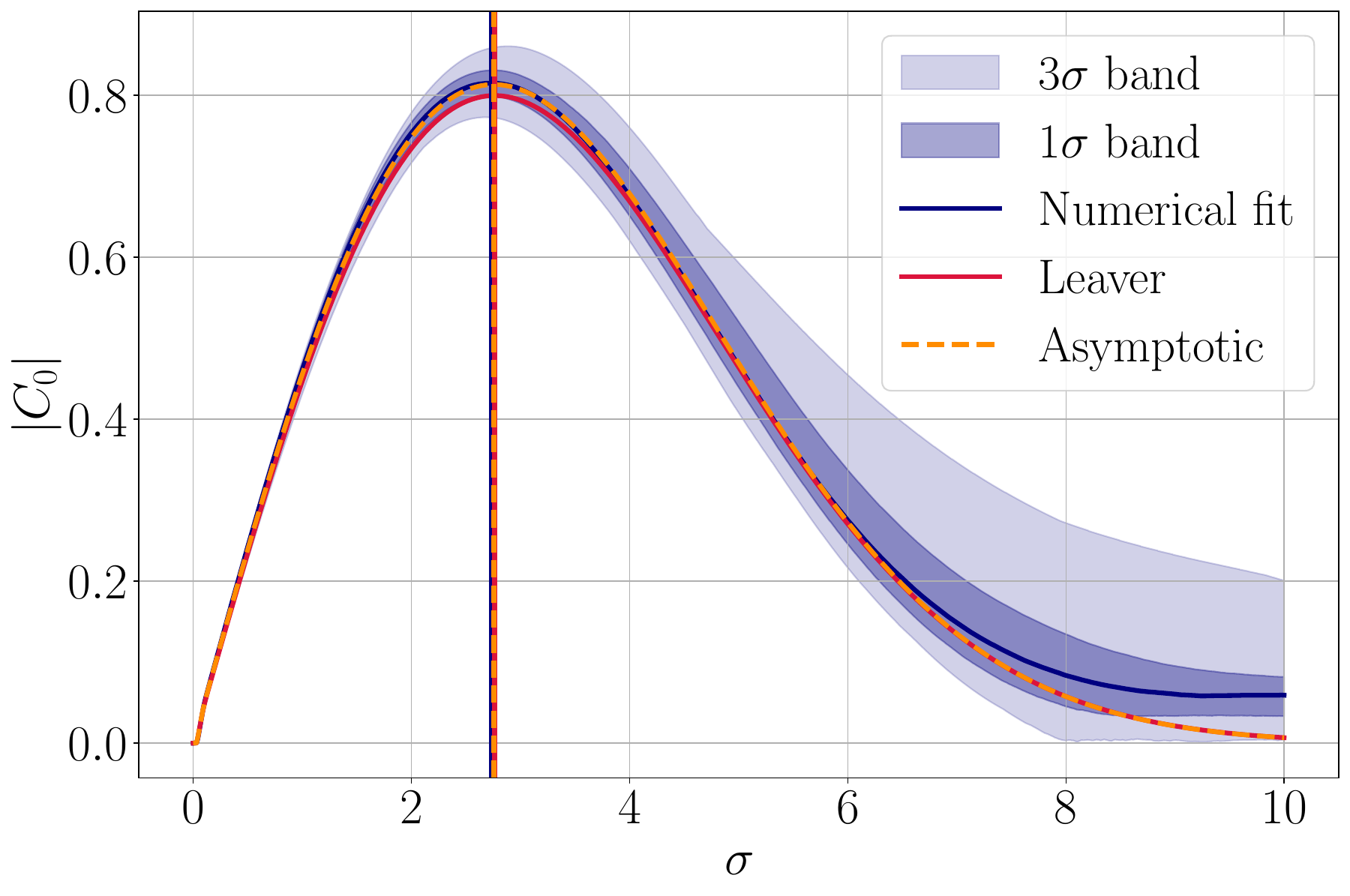
The same formula also predicts an optimal width for a non-oscillatory Gaussian perturbation, $\nu=0$. In this case the excitation behaves approximately as
Defining
the maximum occurs at
For the fundamental Schwarzschild $\ell=2$ mode, this gives an optimal width of order $\sigma_0^\ast\simeq2.75M$, in agreement with the numerical time-domain extraction performed in the paper.
Numerical validation
The analytical picture is tested with time-domain evolutions of the Regge--Wheeler equation. The ringdown amplitudes are extracted using QNMToolkit, a sliding-window fitting method that performs large ensembles of time-domain fits and quantifies the variability associated with the choice of fitting window.
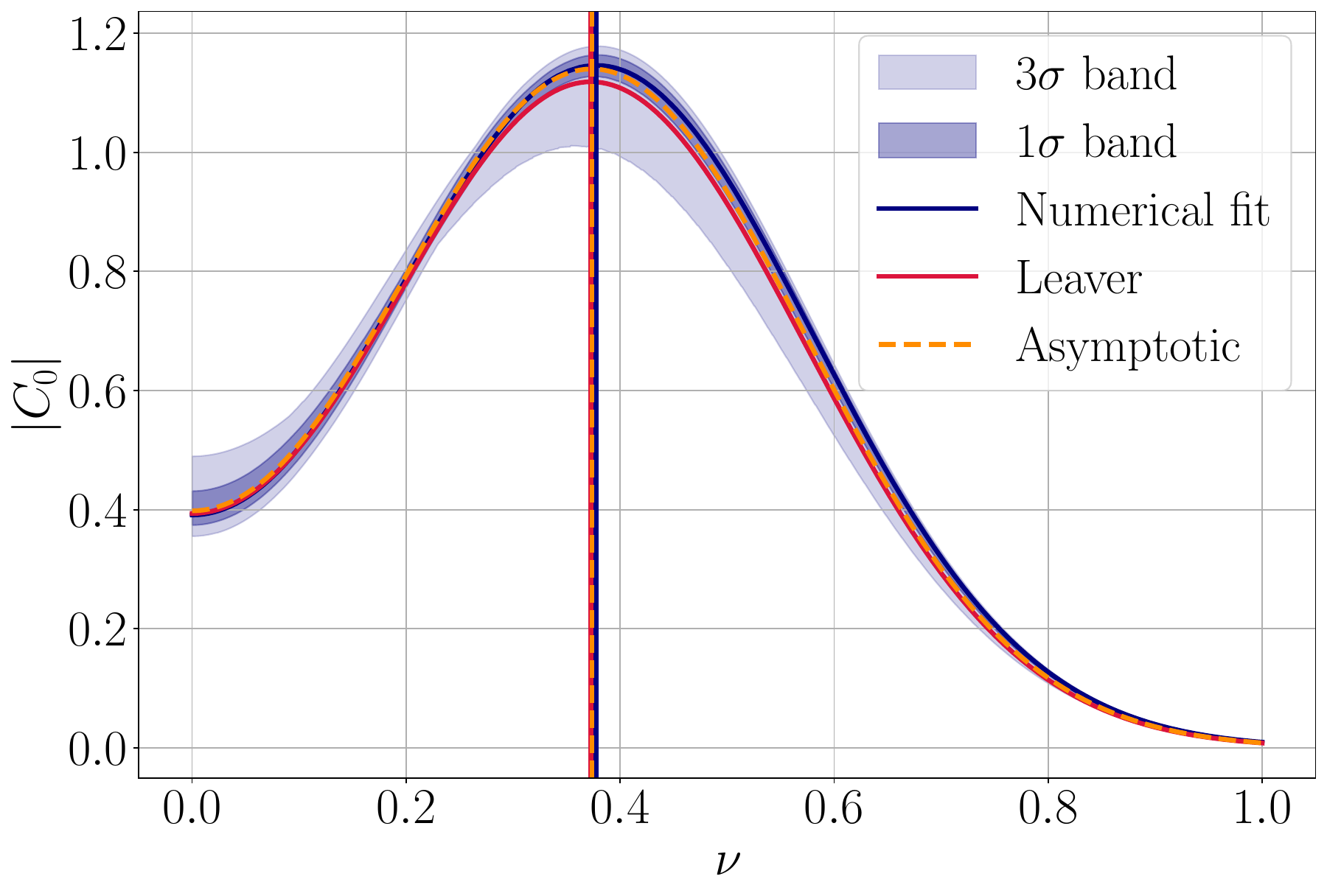
The numerical results support the spectral-filtering picture in two complementary ways. First, for $\nu=0$, the measured excitation has a well-defined maximum near the analytical prediction for $\sigma_0^\ast$. Second, at fixed $\sigma$, scanning the carrier frequency $\nu$ produces a resonance curve whose maximum lies close to the real part of the fundamental QNM frequency,
This provides a direct numerical demonstration that the black hole responds most strongly when the perturbation is spectrally aligned with one of its resonances.
Physical interpretation
The main physical conclusion is that quasinormal-mode amplitudes are not determined by the black hole alone. The geometry fixes the allowed resonant frequencies, but the perturbation determines which of those resonances are populated. The ringdown signal therefore carries information both about the final black hole and about the spectral structure of the process that perturbed it.
This perspective is useful for connecting controlled perturbative calculations with more realistic binary-black-hole mergers. In a merger, the nonlinear dynamics before ringdown can be interpreted as preparing an effective perturbation of the remnant. The subsequent ringdown then filters this perturbation through the QNM spectrum of the final black hole.
Takeaway
The paper provides a compact and quantitative interpretation of black-hole ringdown excitation:
This turns QNM excitation into a controlled spectral-overlap problem and gives a simple way to understand why some perturbations produce strong ringdown signals while others suppress particular modes.
Explore the excitation landscape
Explore the amplitude and phase of the excitation coefficients $C_n$ in the $(\sigma,\nu)$ parameter space of the initial perturbation. The amplitude view shows $\log_{10}|C_n|$, and the phase view shows the continuous, unwrapped phase $\arg C_n$. Both surfaces include the stationary curves obtained directly from the numerical landscapes, together with reference lines such as $\nu=\pm\omega_n^{\rm Re}$. Select the quantity and overtone below, then rotate, zoom, and inspect the three-dimensional surface.